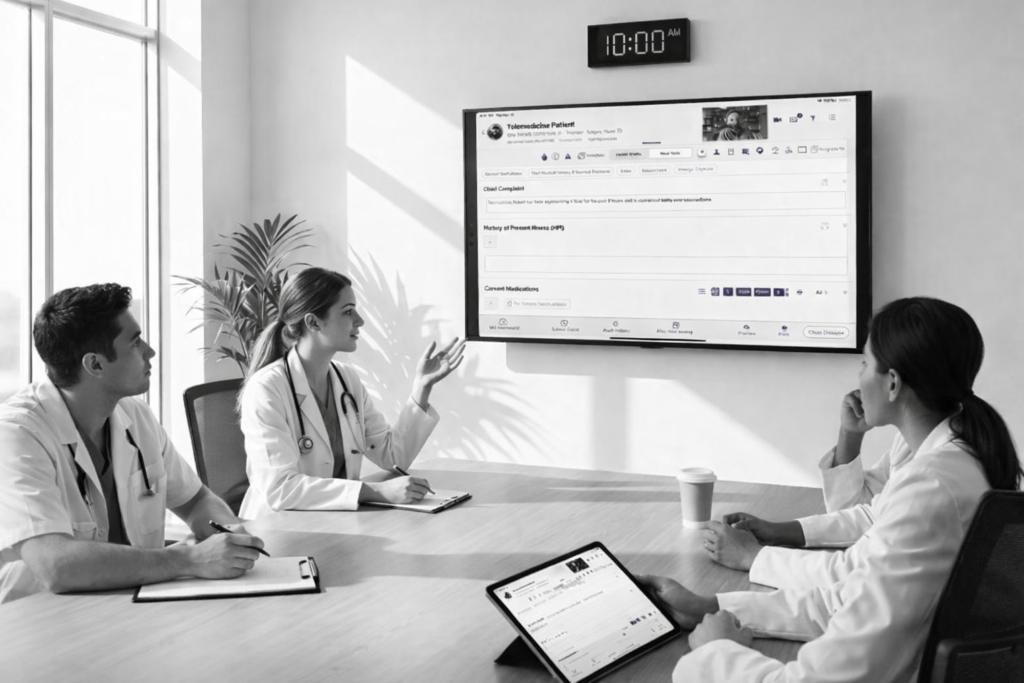
AI ambient charting in primary care reduces documentation time by automatically generating structured SOAP notes during patient visits.

March 5, 2026
AI Ambient Charting in Primary Care: How Physicians Reduce Documentation Time

Primary care physicians face a documentation crisis. Studies show that doctors spend nearly two hours on administrative tasks for every one hour of direct patient care. Many finish their clinical notes long after the last patient has left, squeezing in charting during lunch breaks or late at night. The American Medical Association has consistently identified documentation burden as a leading driver of physician burnout, which now affects more than half of U.S. physicians.
The problem is structural. Electronic Health Records were designed to store data, not to support clinical conversations. Physicians end up typing while patients talk, splitting their attention and reducing the quality of the encounter. Something had to change.
Ambient Charting EHR technology is one of the most meaningful shifts in clinical workflow in recent years. Rather than requiring physicians to manually enter notes during or after a visit, ambient AI listens passively to the conversation, then converts it into structured clinical documentation automatically. This post explains how that process works in practice, what it means for documentation efficiency, and why integration matters more than the technology itself.
What AI Ambient Charting Looks Like During a Real Patient Visit
The best way to understand ambient charting is to follow a typical primary care encounter from start to finish.
A patient checks in for a follow-up visit. Before the physician enters the room, the EHR already has the patient’s history, current medications, and outstanding care gaps loaded. When the physician walks in, they activate the ambient listening session with a simple tap. No microphone to set up. No recorder to manage.
The conversation begins naturally. The patient describes their symptoms. The physician asks follow-up questions. The AI Medical Scribe Software listens in the background, processing the natural language of the exchange in real time. It recognizes clinical context, distinguishing between a patient’s subjective complaints, the physician’s objective findings, and the plan discussed.
By the time the visit ends, the system has already generated a structured SOAP note, including subjective, objective, assessment, and plan sections. The physician reviews the draft, makes any needed edits, and signs off. The note is complete before the patient reaches the front desk.
This is a meaningful departure from the traditional workflow where notes were either typed during the visit or dictated afterward from memory.
How AI Clinical Documentation Software Reduces Time
The time savings come from several places working together, not from a single feature.
- Automated transcription eliminates the need to type out patient history, chief complaint, and review of systems manually
- Predictive charting suggestions surface relevant templates or diagnostic codes based on the content of the conversation
- Reduced manual typing frees the physician to focus on the patient rather than the screen
- Faster coding preparation means the note is structured for accurate documentation review, reducing back-and-forth between clinical and administrative teams
- When integrated with Practice Management software, documented services flow cleanly into billing workflows without duplicate data entry
The cumulative effect is significant. Physicians who previously spent one to two hours completing charts after hours report closing their notes before leaving the exam room. End-of-day chart backlogs shrink. After-hours documentation decreases. Providers describe being more present during visits because they are no longer mentally composing notes while listening to patients.
Accuracy and Clinical Oversight
A common concern with AI-assisted documentation is accuracy. The technology does not replace clinical judgment. It supports it.
Every note generated by AI Clinical Documentation Software goes through physician review before it is finalized. The physician reads, edits, and approves the note. The AI structures the documentation, but the clinical decision-making remains entirely with the provider.
Structured data capture also reduces the risk of missing documentation elements. Ambient charting prompts completeness, making it easier to capture chronic condition management, social determinants of health, and other details that support accurate Risk Adjustment Factor (RAF) scoring. For practices operating under value-based care models, this completeness has a direct impact on quality reporting and reimbursement.
Workflow Integration with Primary Care EHR Software
Ambient charting delivers the most value when it is embedded inside a fully integrated Primary Care EHR Software platform rather than used as a standalone transcription tool.
When ambient charting connects with the broader EHR, a physician can move from reviewing an AI-generated note to ordering labs, renewing a prescription, or sending a referral without switching systems. Telemedicine visits follow the same ambient workflow as in-person encounters. Scheduling, internal messaging, and medication management all feed into the same record.
This integration is what separates useful technology from genuinely transformative workflow change. Fragmented tools create new inefficiencies. An integrated system creates a continuous, coherent clinical experience.
Risk and Compliance Considerations
Privacy and security are reasonable concerns whenever patient conversations are involved. Reputable ambient charting systems are built with HIPAA compliance as a foundation, not an afterthought.
Audio processing occurs through encrypted channels. Data storage follows controlled, cloud-based protocols with access restrictions. Recorded sessions are typically processed and discarded rather than stored long-term. Practices should verify that any ambient charting vendor provides clear documentation of their security architecture and Business Associate Agreement terms before deployment.
These safeguards are well-established in enterprise healthcare technology. The compliance framework for ambient AI follows the same standards already governing telehealth and cloud-based EHR systems.
Why Ambient Charting Is Becoming Essential in Primary Care
Several forces are converging to make AI-assisted documentation a practical necessity rather than an optional upgrade.
Patient volumes in primary care continue to rise. Staffing shortages make it harder to delegate administrative tasks to support staff. Value-based care requirements demand more complete and precise documentation to qualify for quality incentives. All of this increases the documentation burden on physicians at a time when burnout is already a significant workforce challenge.
Ambient charting addresses these pressures directly. It reduces the clerical weight on physicians without reducing the quality of documentation. For practices managing complex patient panels under value-based contracts, accurate and complete charting also has a measurable revenue impact.
The Difference Integration Makes
AI ambient charting is not a luxury feature reserved for large health systems. It is increasingly accessible to independent primary care practices through modern, integrated EHR platforms.
The practices that benefit most are those where ambient charting works alongside scheduling, Practice Management, lab ordering, and communication tools rather than sitting outside the core workflow. Physicians finish notes faster, spend more time focused on patients, and end their days with charts closed.
Learn how Althea Smart EHR integrates AI ambient charting into real-world primary care workflows. Visit https://www.mdsynergy.com to schedule a demo.
Book Your
Demo Today
Our simple to use, online appointment process makes it easy for you to book for any one of our services and doctors.