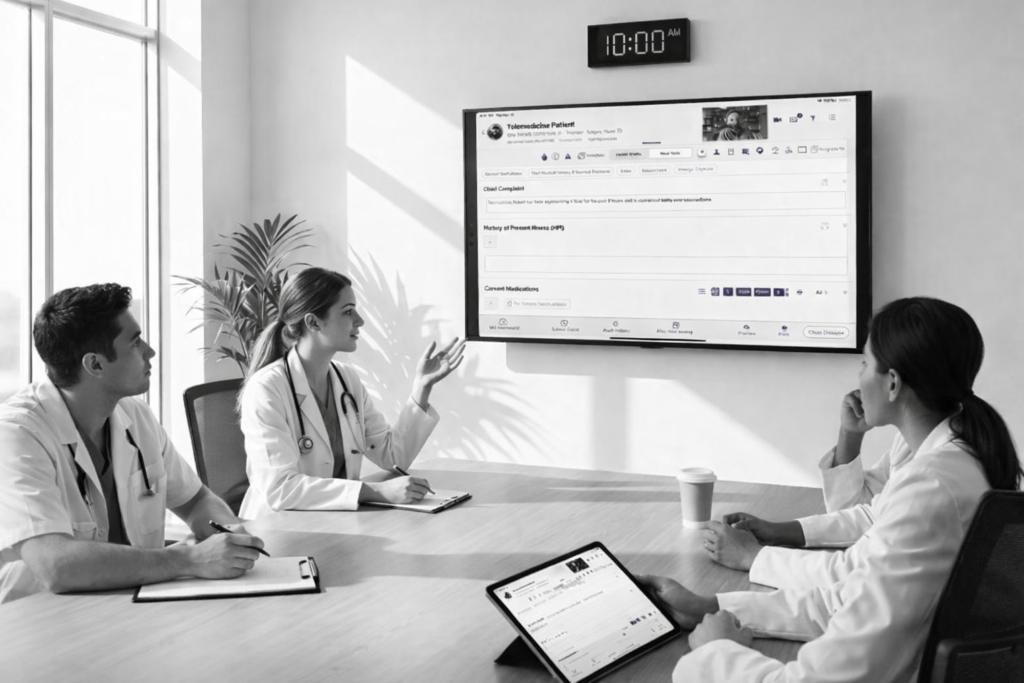
AI-powered EHR systems with clinical assistants are helping primary care, family medicine, internal medicine, and pain management physicians reduce documentation burden, review charts faster, and improve coding accuracy.
March 11, 2026
AI-Powered EHR with Clinical Assistant: The Future of Primary Care

Primary care physicians face increasing pressure. Patient volumes are rising, documentation requirements are expanding, and reimbursement models are becoming more complex.
AI-powered EHR systems for primary care are emerging as an important solution. By integrating AI clinical assistants directly into the Electronic Health Record, physicians can review patient charts faster, automate documentation, and identify coding opportunities without spending hours navigating complex medical records.
Unfortunately, many traditional EHR systems still slow clinicians down rather than support them.
This challenge is felt across primary care, family medicine, internal medicine, and pain management practices, where physicians manage large volumes of complex patient data every day.
AI-powered Electronic Health Records are beginning to change the landscape.
Modern platforms introducing AI-enabled EHR systems bring intelligent clinical assistants directly into the physician workflow. These assistants help physicians understand patient data faster, document visits automatically, and identify coding opportunities.
Instead of spending hours navigating charts, providers can focus on what matters most, patient care.
Across the healthcare technology industry, companies are exploring these capabilities. For example, MD Synergy Solutions is researching AI clinical assistant functionality as part of the ongoing evolution of its Althea Smart EHR platform. The platform is being designed with a mobile-first native application architecture, recognizing that physicians increasingly need secure access to patient information directly from their mobile devices as well as the desktop.
Why Primary Care Needs AI-Driven EHR Systems
Primary care providers manage a wide range of patient conditions including chronic disease monitoring, preventive screenings, and care coordination.
This is also true for physicians practicing family medicine, internal medicine, and pain management, where patient charts often contain years of clinical data.
As a result, patient records become complex and difficult to navigate.
Traditional EHR systems require physicians to manually search through years of clinical notes, lab results, medication histories, specialist reports, and imaging studies.
AI changes this experience completely.
With an AI Clinical Assistant, physicians can instantly understand the patient’s medical history, identify risk factors, and prepare for visits without manually reviewing hundreds of data points.
The result is significant time savings, reduced burnout, and better patient care.
Key AI Features Transforming Primary Care EHRs
Chat with the Patient Chart
Imagine being able to ask your EHR questions about a patient.
With AI-powered chart interaction, physicians can type questions such as:
What medications is this patient currently taking?
Show me the last three A1C results.
What chronic conditions does this patient have?
When was the patient’s last MRI?
The AI scans the entire patient record and provides the answer immediately.
For physicians in primary care, family medicine, internal medicine, and pain management, this eliminates the need to manually search through multiple tabs or past visit notes. Important information becomes available within seconds.
AI Clinical Timeline
Patient histories are often scattered across lab results, clinical notes, imaging reports, and specialist documents.
An AI Clinical Timeline organizes this information into a clear chronological view.
This allows physicians to quickly see key diagnoses, lab trends, medication changes, procedures, and hospitalizations.
Instead of reviewing years of notes, providers can understand the patient’s medical journey within seconds.
AI Visit Preparation
Preparing for a patient visit can take several minutes per chart. When multiplied across a full clinic schedule, the time quickly adds up.
AI-powered visit preparation automatically summarizes important patient information before the visit, including active conditions, recent labs, care gaps, medication changes, and preventive care reminders.
This is particularly valuable for busy primary care and internal medicine practices managing high patient volumes.
Physicians can walk into the exam room already prepared without spending additional time reviewing the chart.
Ambient Documentation
Documentation remains one of the biggest contributors to physician burnout.
Ambient AI documentation listens to the conversation between the physician and patient during the visit and automatically generates structured clinical notes.
This technology can capture the history of present illness, review of systems, assessment and plan, and medical decision making.
Instead of typing during the visit, physicians can maintain eye contact and focus on the patient.
For specialties such as pain management and family medicine, where patient conversations are often detailed, ambient documentation can significantly reduce after-hours charting.
Intelligent Coding and RAF Detection
Accurate coding is critical for both compliance and reimbursement. However, many conditions remain undocumented or under coded.
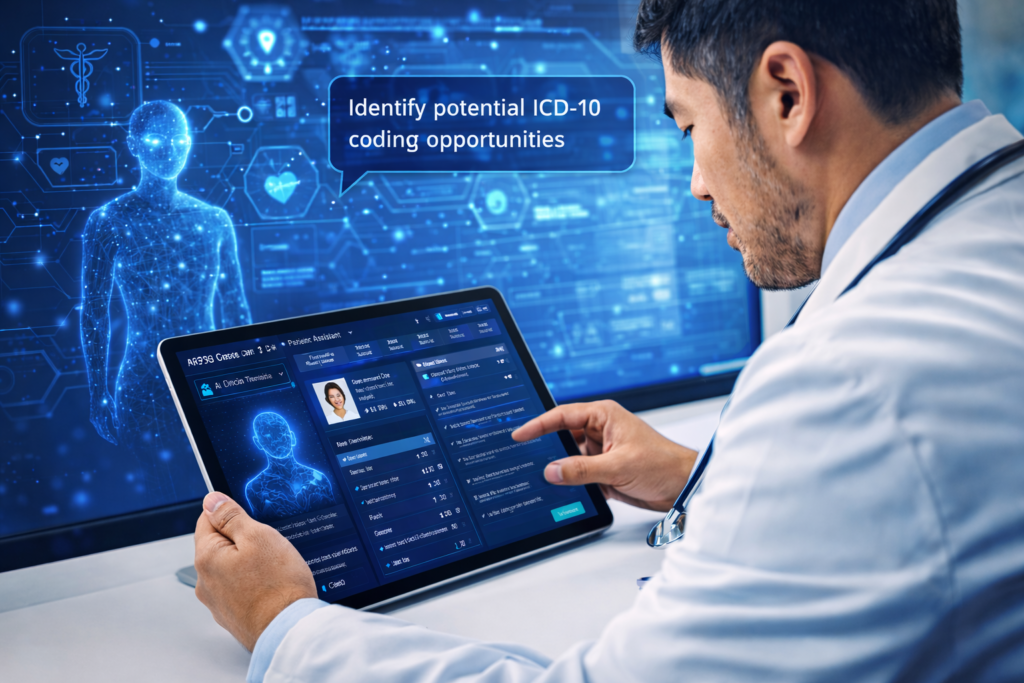
AI-powered EHR systems can analyze the patient chart and identify potential ICD-10 coding opportunities, HCC conditions, and Risk Adjustment Factor gaps.
For primary care and internal medicine practices participating in value-based care, this capability can significantly improve financial performance while ensuring accurate documentation.
Why Physicians Appreciate AI Clinical Assistants in EHR
Ask physicians what they dislike most about traditional EHR systems and the answers are remarkably consistent.
Common frustrations include excessive clicking, heavy documentation requirements, coding confusion, and time-consuming chart reviews.
These challenges affect physicians across primary care, family medicine, internal medicine, and pain management practices.
An AI clinical assistant embedded within the EHR can address these issues.
Physicians spend less time navigating multiple screens because they can simply ask the chart for the information they need.
Ambient documentation reduces the burden of writing lengthy notes.
AI tools highlight possible diagnoses and RAF opportunities to simplify coding.
AI-generated summaries and timelines make chart review much faster.
The EHR begins to function as a clinical assistant rather than just a record system.
Example Questions Physicians Can Ask the Patient Chart
One of the most powerful aspects of an AI-enabled EHR is the ability to interact with the patient chart using natural language.
Instead of searching through tabs and notes, physicians can ask the EHR questions and receive instant answers.
Examples include:
What medications is the patient currently taking?
When was the last opioid prescription issued?
Has the patient previously taken gabapentin?
Show the last three A1C results.
Has the patient ever had abnormal liver function tests?
What were the patient’s most recent lipid panel results?
When was the patient’s last colonoscopy?
Is the patient due for a mammogram?
What preventive screenings are overdue?
Summarize the patient’s last visit.
What medications were changed during the previous appointment?
What were the key clinical concerns during the last encounter?
For busy physicians, this capability can dramatically reduce chart review time.
Traditional EHR vs AI-Powered EHR
Traditional EHR systems often require manual chart review, multiple clicks to find information, manual visit documentation, and coding performed entirely by the physician.
AI-powered EHR systems with clinical assistants provide automatic chart summaries, natural language chart interaction, ambient documentation during visits, and intelligent coding suggestions.
The result is a dramatic reduction in administrative workload.
Benefits of an AI Clinical Assistant in Primary Care
When AI is integrated into the EHR workflow, practices experience several meaningful benefits.
Physicians experience less burnout because repetitive administrative tasks are automated.
Clinical decision making becomes faster because relevant patient insights are easier to access.
Patient experience improves because physicians spend more time interacting with patients rather than typing into the computer.
Financial performance improves through more accurate coding and RAF detection.
Practice efficiency improves because staff spend less time managing documentation and chart preparation.
The Future of Primary Care EHR
Healthcare is entering a new era where EHR systems become intelligent clinical partners rather than passive data repositories.
Many traditional EHR platforms were originally designed decades ago as desktop documentation systems and have gradually added new features over time.
Today, newer platforms are being designed with AI assistance, mobile-first workflows, and modern user experiences in mind.
AI-enabled platforms will continue to evolve with capabilities such as predictive care insights, automated clinical workflows, real-time decision support, and population health analytics.
Practices that adopt AI-driven EHR technology today will be better positioned for the future of value-based healthcare.
Frequently Asked Questions
What is an AI clinical assistant in an EHR?
An AI clinical assistant is a technology embedded within an Electronic Health Record that helps physicians analyze patient charts, generate documentation, and retrieve clinical insights quickly.
How does AI improve EHR for primary care physicians?
AI can summarize patient charts, prepare visit summaries, generate documentation, and identify coding opportunities. This allows physicians to focus more on patient care.
Can AI-powered EHR systems help family medicine and internal medicine practices?
Yes. AI tools help physicians quickly review patient histories, identify chronic conditions, and prepare for visits more efficiently.
Does AI help with risk adjustment and RAF coding?
AI-powered EHR systems can analyze patient charts and identify HCC conditions and RAF opportunities, helping ensure accurate documentation for value-based care programs.
Will AI replace physicians?
No. AI is designed to assist physicians rather than replace them. These technologies reduce administrative work and provide faster clinical insights.
Final Thoughts
Primary care physicians deserve technology that works with them instead of against them.
An EHR equipped with an AI Clinical Assistant transforms the clinical workflow by allowing providers to chat with patient charts, view AI-generated clinical timelines, prepare for visits automatically, capture notes through ambient documentation, and detect coding and RAF opportunities.
The result is a smarter and more efficient practice where physicians can focus on delivering exceptional patient care.
If you’d like, I can also show you one tiny human-style tweak that makes blogs like this feel even less AI-written and more like a physician founder wrote it (very helpful for LinkedIn traffic).
Book Your
Demo Today
Our simple to use, online appointment process makes it easy for you to book for any one of our services and doctors.