The End of Note Taking. The Beginning of Better Care.

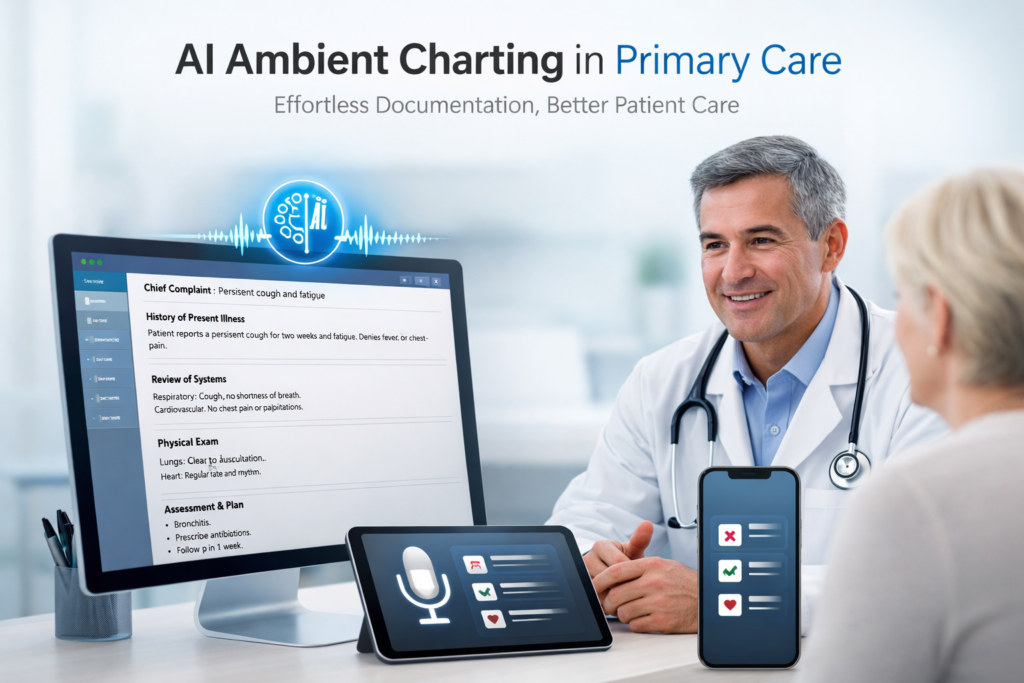
AI Ambient Charting in primary care is transforming how physicians document patient visits. Instead of typing into an EHR, providers can now rely on AI-powered ambient charting to automatically generate clinical notes in real time. As a result, efficiency improves, burnout decreases, and patient engagement becomes more meaningful.

Primary care physicians didn’t sign up to become data entry specialists. However, documentation has increasingly taken over the clinical workflow. AI Ambient Charting changes that completely.


What Is AI Ambient Charting?

AI Ambient Charting listens to the natural conversation between a physician and a patient. It then converts that conversation into structured clinical documentation in real time.

There is no typing, no clicking, and no disruption to the visit.

In addition, the system captures:

  • Chief complaint
  • History of present illness (HPI)
  • Review of systems (ROS)
  • Physical exam findings
  • Assessment and plan

Therefore, physicians can stay fully focused on the patient.


AI Ambient Charting in Primary Care: Why It’s Trending

AI ambient charting is quickly becoming one of the most impactful innovations in primary care. Not only does it reduce documentation time, but it also improves clinical workflow and supports accurate coding.

As a result, practices are increasingly adopting AI-powered EHR systems to stay competitive. Meanwhile, patients benefit from more attentive and engaged physicians.

Learn how physicians are already reducing documentation time with AI in our detailed guide on reducing documentation time.


How AI Ambient Charting Improves Primary Care Efficiency

Primary care visits are complex. They often involve multiple chronic conditions, medication reconciliation, and preventive care discussions.

AI Ambient Charting helps by organizing all of this information automatically. In addition, it ensures that important details are not missed, which supports better clinical decisions and more accurate coding.

Therefore, physicians can deliver higher-quality care in less time.


Real-World Workflow: Before vs After

Before AI Ambient Charting

  • Physicians type during the visit
  • Eye contact with patients is reduced
  • Notes are completed after clinic hours
  • Burnout increases over time

After AI Ambient Charting

  • Physicians speak naturally
  • Patient interaction improves
  • Notes are generated instantly
  • Charts are closed the same day

Key Benefits for Primary Care Practices

Save 2–3 Hours Per Day

AI Ambient Charting eliminates after-hours charting and reduces administrative workload.

Improve Patient Experience

Because physicians are not distracted by screens, they can focus entirely on the patient.

Increase Revenue Accuracy

More complete documentation supports accurate coding, including HCC and RAF scoring.

Reduce Burnout

Less clerical work leads to better work-life balance and improved physician satisfaction.

Faster Chart Completion

Charts can be reviewed and signed immediately after the visit.


How It Works

  1. The patient visit begins
  2. AI listens passively in the background
  3. The conversation is processed in real time
  4. A structured clinical note is generated
  5. The physician reviews and signs the note

Why Althea Smart EHR Stands Out

Platforms like Althea Smart EHR are leading this shift by integrating AI Ambient Charting directly into the clinical workflow.

Unlike add-on solutions, this approach is fully embedded within the EHR. As a result, there is less friction and greater accuracy.

Key advantages include:

  • Native AI integration
  • Specialty-aware documentation
  • Built-in coding support (HCC/RAF)
  • Works for both in-person and telemedicine visits
  • Designed for small to mid-sized practices

Common Concerns (And the Reality)

Will AI make mistakes?

AI generates draft documentation. However, physicians always review and finalize notes before signing.

Does it slow down the visit?

No. In fact, it speeds up the visit by removing documentation interruptions.

Is it secure and compliant?

Yes. When implemented within a secure EHR environment, AI Ambient Charting meets all required compliance standards.


Frequently Asked Questions (FAQ)

What is AI Ambient Charting in primary care?

AI Ambient Charting is a technology that listens to doctor-patient conversations and automatically creates structured clinical notes in real time.


How accurate is AI Ambient Charting?

It is highly accurate when trained on clinical workflows. However, physicians always review and approve the final note.


Can AI Ambient Charting handle complex visits?

Yes. It is particularly effective in primary care, where visits involve multiple conditions, medications, and preventive care discussions.


How much time can physicians save?

Most providers save between 2 to 3 hours per day by eliminating manual documentation.


Does it work with telemedicine?

Yes. AI Ambient Charting works seamlessly with both in-person and virtual visits.


Will it improve coding accuracy?

Yes. More complete documentation supports better coding, including HCC and RAF scoring.


Is it difficult to implement?

No. Modern EHR platforms offer simple onboarding and minimal training requirements.


What makes Althea Smart EHR different?

It offers fully integrated AI capabilities, including ambient charting, predictive documentation, and value-based care insights within a single platform.


Final Thought

AI Ambient Charting in primary care is not just a feature. It is a fundamental shift in how medicine is practiced.

Physicians can now focus on what truly matters listening, diagnosing, and caring while AI handles the documentation.

Previous

Maximizing Telehealth Success Through EHR Integration

Next

How AI Ambient Charting Is Replacing Traditional...

Primary care physicians face increasing pressure. Patient volumes are rising, documentation requirements are expanding, and reimbursement models are becoming more complex.

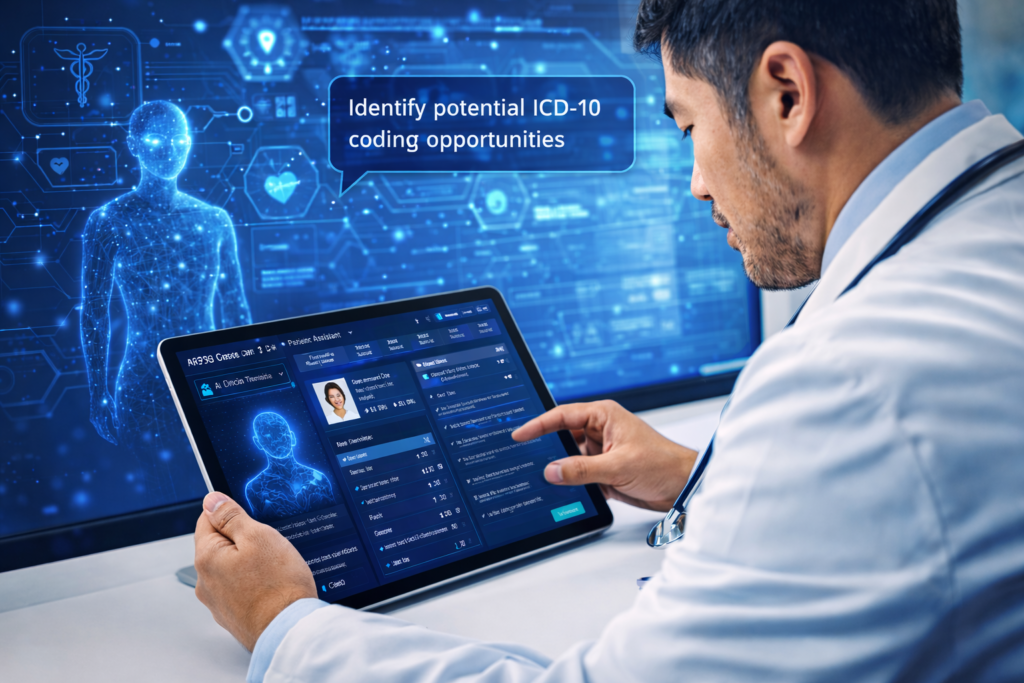
AI-powered EHR systems for primary care are emerging as an important solution. By integrating AI clinical assistants directly into the Electronic Health Record, physicians can review patient charts faster, automate documentation, and identify coding opportunities without spending hours navigating complex medical records.

Unfortunately, many traditional EHR systems still slow clinicians down rather than support them.

This challenge is felt across primary care, family medicine, internal medicine, and pain management practices, where physicians manage large volumes of complex patient data every day.

AI-powered Electronic Health Records are beginning to change the landscape.

Modern platforms introducing AI-enabled EHR systems bring intelligent clinical assistants directly into the physician workflow. These assistants help physicians understand patient data faster, document visits automatically, and identify coding opportunities.

Instead of spending hours navigating charts, providers can focus on what matters most, patient care.

Across the healthcare technology industry, companies are exploring these capabilities. For example, MD Synergy Solutions is researching AI clinical assistant functionality as part of the ongoing evolution of its Althea Smart EHR platform. The platform is being designed with a mobile-first native application architecture, recognizing that physicians increasingly need secure access to patient information directly from their mobile devices as well as the desktop.

Why Primary Care Needs AI-Driven EHR Systems

Primary care providers manage a wide range of patient conditions including chronic disease monitoring, preventive screenings, and care coordination.

This is also true for physicians practicing family medicine, internal medicine, and pain management, where patient charts often contain years of clinical data.

As a result, patient records become complex and difficult to navigate.

Traditional EHR systems require physicians to manually search through years of clinical notes, lab results, medication histories, specialist reports, and imaging studies.

AI changes this experience completely.

With an AI Clinical Assistant, physicians can instantly understand the patient’s medical history, identify risk factors, and prepare for visits without manually reviewing hundreds of data points.

The result is significant time savings, reduced burnout, and better patient care.

Key AI Features Transforming Primary Care EHRs

Chat with the Patient Chart

Imagine being able to ask your EHR questions about a patient.

With AI-powered chart interaction, physicians can type questions such as:

What medications is this patient currently taking?
Show me the last three A1C results.
What chronic conditions does this patient have?
When was the patient’s last MRI?

The AI scans the entire patient record and provides the answer immediately.

For physicians in primary care, family medicine, internal medicine, and pain management, this eliminates the need to manually search through multiple tabs or past visit notes. Important information becomes available within seconds.

AI Clinical Timeline

Patient histories are often scattered across lab results, clinical notes, imaging reports, and specialist documents.

An AI Clinical Timeline organizes this information into a clear chronological view.

This allows physicians to quickly see key diagnoses, lab trends, medication changes, procedures, and hospitalizations.

Instead of reviewing years of notes, providers can understand the patient’s medical journey within seconds.

AI Visit Preparation

Preparing for a patient visit can take several minutes per chart. When multiplied across a full clinic schedule, the time quickly adds up.

AI-powered visit preparation automatically summarizes important patient information before the visit, including active conditions, recent labs, care gaps, medication changes, and preventive care reminders.

This is particularly valuable for busy primary care and internal medicine practices managing high patient volumes.

Physicians can walk into the exam room already prepared without spending additional time reviewing the chart.

Ambient Documentation

Documentation remains one of the biggest contributors to physician burnout.

Ambient AI documentation listens to the conversation between the physician and patient during the visit and automatically generates structured clinical notes.

This technology can capture the history of present illness, review of systems, assessment and plan, and medical decision making.

Instead of typing during the visit, physicians can maintain eye contact and focus on the patient.

For specialties such as pain management and family medicine, where patient conversations are often detailed, ambient documentation can significantly reduce after-hours charting.

Intelligent Coding and RAF Detection

Accurate coding is critical for both compliance and reimbursement. However, many conditions remain undocumented or under coded.

AI-powered EHR systems can analyze the patient chart and identify potential ICD-10 coding opportunities, HCC conditions, and Risk Adjustment Factor gaps.

For primary care and internal medicine practices participating in value-based care, this capability can significantly improve financial performance while ensuring accurate documentation.

Previous

Maximizing Telehealth Success Through EHR Integration

Next

How AI Ambient Charting Is Replacing Traditional...

In today’s fast-paced healthcare environment, physicians face increasing documentation demands that take time away from patient care. As a result, many providers are turning to AI-powered EHR systems to streamline workflows and reduce administrative burden.

One of the most impactful innovations is AI predictive charting in EHR systems. Althea Smart EHR uses artificial intelligence to analyze your clinical patterns and automatically suggest orders, diagnoses, and treatment plans—helping you chart faster and more accurately.


What Is AI Predictive Charting in EHR?

AI predictive charting is an advanced feature within modern electronic health record systems that uses machine learning to anticipate clinical actions.

Instead of repeatedly entering the same orders, the system learns from your historical data and suggests the most relevant next steps. Over time, it becomes more accurate and personalized to your workflow.


How AI Improves EHR Systems

Artificial intelligence is transforming how providers interact with EHR platforms. With predictive charting:

  • Documentation becomes faster and more efficient
  • Clinical accuracy improves through data-driven suggestions
  • Providers spend more time with patients instead of screens

As a result, AI in EHR systems is quickly becoming essential for modern medical practices.


Key Benefits of AI Predictive Charting

Reduce Documentation Time

AI predictive charting significantly decreases manual data entry by automatically suggesting orders and treatment plans based on past encounters. As a result, providers can complete charts faster and focus more on patient care.

Learn Your Clinical Workflow

Unlike traditional EHR templates, predictive charting adapts to your unique treatment style. Over time, the system refines its recommendations, ensuring alignment with your clinical preferences.

Improve Clinical Accuracy

By leveraging historical data and intelligent suggestions, predictive charting reduces variability and minimizes documentation errors. This leads to more consistent and reliable patient records.

Deliver Actionable Insights

The system continuously evolves with usage. Therefore, each patient encounter benefits from increasingly accurate and meaningful recommendations.


AI Predictive Charting + Ambient Charting: A Complete Solution

AI predictive charting becomes even more powerful when combined with ambient charting.

  • Ambient charting captures real-time patient-provider conversations
  • Predictive charting builds on that data to suggest next steps

Together, they create a seamless, end-to-end clinical documentation workflow.


Why AI-Powered EHR Is the Future

Healthcare is rapidly shifting toward automation and intelligence-driven workflows. Practices that adopt AI-powered EHR solutions gain:

  • Increased efficiency
  • Reduced physician burnout
  • Better patient outcomes

As a result, AI predictive charting is becoming a critical competitive advantage for modern practices.


Discover the Future of EHR with AI

AI predictive charting is transforming clinical documentation by making it faster, smarter, and more personalized.

By combining predictive intelligence with ambient charting, Althea Smart EHR enables providers to reduce administrative burden while improving patient care.

Ready to see it in action?
Althea Smart EHR


FAQ

What is AI predictive charting in EHR?

AI predictive charting uses machine learning to suggest orders, diagnoses, and treatments based on historical clinical data.

How does AI reduce documentation time?

It automates repetitive tasks and provides intelligent suggestions, reducing manual data entry.

Is AI in EHR systems safe?

Yes, when designed with HIPAA compliance, AI enhances accuracy and efficiency without compromising data security.

Previous

Maximizing Telehealth Success Through EHR Integration

Next

How AI Ambient Charting Is Replacing Traditional...

Why Physicians Are Switching to AI-Powered EHR Systems

In today’s fast-paced healthcare environment, physicians are under constant pressure to improve efficiency while delivering high-quality patient care. Traditional electronic health record systems often create more administrative burden than value.

This is why many practices are now turning to AI-powered EHR systems that automate documentation, streamline workflows, and reduce physician burnout.

Althea Smart EHR is designed specifically to solve these challenges, helping providers focus more on patients and less on paperwork.


What Makes Althea Smart EHR Different?

Unlike traditional EHR systems, Althea Smart EHR combines artificial intelligence, mobility, and intuitive design into one powerful platform.

It is built for modern healthcare practices that need speed, flexibility, and accuracy.


Key Features of Althea Smart EHR

1. AI-Powered Ambient Charting

Althea Smart EHR uses ambient listening and voice recognition to automatically generate clinical notes in real time.

This significantly reduces documentation time and allows physicians to stay focused on patient interaction instead of typing.


2. Mobile EHR for iPhone and iPad

Designed as a native iOS application, Althea Smart EHR enables providers to access patient records, complete charting, and manage workflows from anywhere.

Mobility is essential for modern practices, and Althea delivers a seamless mobile-first experience.


3. Intuitive and Physician-Friendly Design

The platform is built with physicians in mind.

Simple navigation, minimal clicks, and streamlined workflows make it easy for both providers and staff to use from day one.


4. Integrated Telehealth Capabilities

With built-in telemedicine features, physicians can conduct virtual visits directly within the EHR.

This ensures continuity of care while improving patient access and convenience.


How AI-Powered EHR Improves Clinical Efficiency

AI-driven EHR systems like Althea Smart EHR help practices:

  • Reduce documentation time
  • Improve accuracy of clinical notes
  • Increase patient volume without added burden
  • Enhance care coordination
  • Reduce physician burnout

These benefits translate into better outcomes for both providers and patients.


Top-Rated EHR by Healthcare Providers

Althea Smart EHR has received strong ratings across platforms like Capterra, Software Advice, and GetApp.

Healthcare providers consistently highlight:

  • Ease of use
  • Fast onboarding and training
  • Responsive customer support
  • Immediate improvement in workflow efficiency

Many practices report a smooth transition from legacy systems with minimal disruption.


Why Forward-Thinking Practices Choose Althea Smart EHR

Modern healthcare requires more than just record-keeping — it demands intelligent systems that actively improve care delivery.

Althea Smart EHR combines:

  • AI-powered documentation
  • Mobile-first design
  • Integrated telehealth
  • Workflow automation

This makes it an ideal solution for primary care, internal medicine, and multi-specialty practices.


Ready to Experience a Smarter EHR?

If your current EHR is slowing you down, it may be time to switch to a system built for today’s healthcare environment.

Althea Smart EHR helps you improve efficiency, reduce administrative burden, and focus on what matters most — your patients.

Previous

Maximizing Telehealth Success Through EHR Integration

Next

How AI Ambient Charting Is Replacing Traditional...