Introduction

Choosing the right Electronic Health Record system has become one of the most important decisions for medical practices today. Many providers feel stuck using outdated systems that slow them down instead of helping them deliver better care.

If you are searching for EHR alternatives, you are not alone. Practices across the country are actively switching to more modern platforms that improve workflow efficiency, reduce documentation burden, and support value based care.

This guide breaks down how to evaluate EHR alternatives, what features matter most, and how newer AI driven platforms are changing the landscape.


Why Practices Are Looking for EHR Alternatives

Healthcare providers are moving away from traditional EHR systems for several reasons.

Common challenges with legacy EHR systems

  • Excessive clicks and time spent charting
  • Poor user experience and outdated interface
  • Limited support for value based care workflows
  • High costs for setup, training, and data migration
  • Difficulty accessing patient data across systems
  • Lack of innovation in AI and automation

Many of these systems were designed years ago and have not evolved to meet modern clinical demands.


What to Look for in an EHR Alternative

When comparing EHR systems, it is important to focus on features that directly impact clinical efficiency and financial performance.

1. Ease of Use and Speed

A modern EHR should reduce clicks and allow providers to complete documentation quickly. Intuitive workflows and mobile access are essential.

2. AI Driven Documentation

AI powered tools such as ambient charting and predictive charting can significantly reduce documentation time and physician burnout.

3. Value Based Care Support

Look for features that help identify care gaps, track RAF Scores, and improve HCC coding accuracy.

4. Interoperability

Seamless integration with labs, radiology, pharmacies, and health information exchanges is critical.

5. Patient Engagement Tools

Patient portals, automated notifications, and digital communication improve patient satisfaction and reduce administrative workload.

6. Transparent Pricing and Flexibility

Avoid systems with hidden fees or restrictive contracts. Look for vendors offering flexible onboarding and risk free switching options.

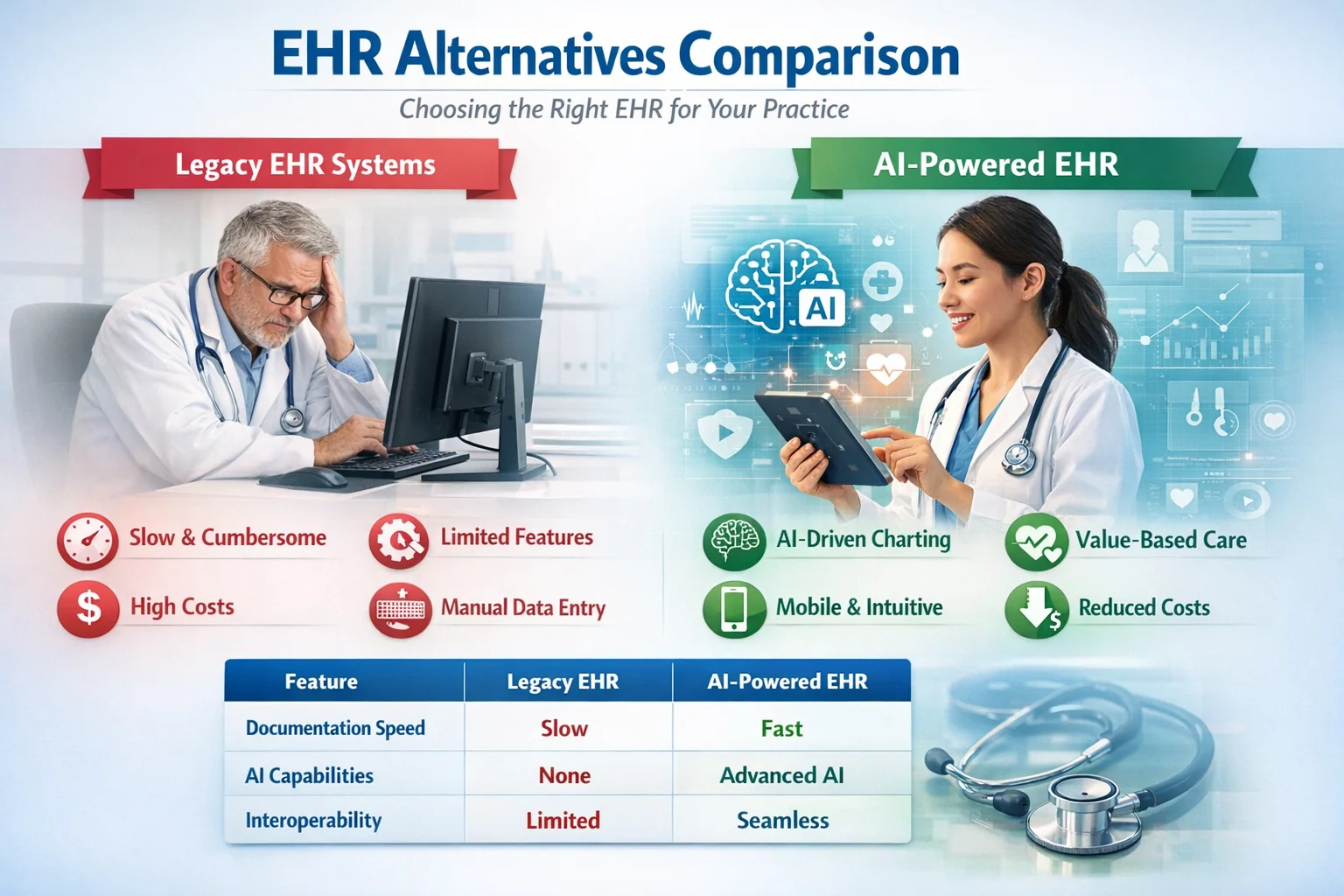
EHR Comparison Table

Below is a simplified comparison of common EHR categories to help guide your decision.

Feature Legacy EHR Systems Cloud Based EHR AI Powered EHR
User Experience Complex and outdated Improved Modern and intuitive
Documentation Speed Slow Moderate Fast with automation
AI Capabilities Limited Basic Advanced AI assistance
Value Based Care Tools Minimal Moderate Built in and proactive
Mobile Access Limited Available Fully optimized
Setup Costs High Moderate Often low or zero
Innovation Slow Moderate Rapid

Why AI Powered EHR Systems Are Gaining Momentum

The biggest shift in healthcare technology today is the adoption of AI powered EHR platforms.

These systems go beyond basic record keeping and actively assist providers during patient care.

Key advantages

  • Ambient charting that captures visits automatically
  • Predictive suggestions for orders and treatment plans
  • AI driven insights for RAF and HCC coding
  • Faster documentation with fewer clicks
  • Improved compliance and accuracy

Practices using modern platforms are seeing measurable improvements in both efficiency and revenue.


A Modern Approach to EHR: What Sets New Platforms Apart

New generation EHR systems are designed with physicians in mind.

Instead of forcing providers to adapt to software, these platforms adapt to how clinicians work.

For example, solutions like Althea Smart EHR from MD Synergy focus on:

  • Mobile first workflows for iPhone and iPad
  • AI powered clinical assistance
  • Real time patient data access
  • Integrated communication tools
  • Simplified user experience inspired by consumer technology

This shift is helping practices spend more time with patients and less time on documentation.


When Should You Switch Your EHR

If your current system is holding your practice back, it may be time to consider switching.

Signs you need an EHR alternative

  • You spend more time charting than seeing patients
  • Your system does not support value based care initiatives
  • Staff productivity is declining
  • Reporting and analytics are limited
  • You are paying high fees with little return

Switching EHR systems used to be difficult, but modern vendors now offer streamlined migration processes with minimal disruption.

How to Evaluate EHR Alternatives

Before making a decision, follow a structured evaluation process.

Step by step approach

  1. Identify your practice needs and workflows
  2. Request live demos focused on real clinical scenarios
  3. Compare features that impact efficiency and revenue
  4. Review total cost including hidden fees
  5. Ask about Data Migration and onboarding support
  6. Speak with current users for real feedback

Taking the time to evaluate properly can prevent costly mistakes.


Conclusion

The EHR landscape is evolving rapidly. Practices that continue using outdated systems risk falling behind in both efficiency and patient care.

Exploring EHR alternatives is not just about switching software. It is about transforming how your practice operates.

Modern AI powered platforms are helping providers reduce burnout, improve documentation accuracy, and increase revenue opportunities.

Practices that adopt the right technology today will be better positioned for the future of healthcare.

FAQ Section for SEO

What is the best EHR alternative in 2026

The best EHR alternative depends on your practice size and specialty. Many providers are choosing AI powered EHR systems that offer faster documentation, better workflows, and improved value based care support.

Why are doctors switching EHR systems

Doctors are switching due to poor usability, high costs, and lack of innovation in older systems. Modern EHR alternatives provide better efficiency and reduce administrative burden.

Are AI powered EHR systems worth it

Yes AI powered EHR systems can significantly reduce documentation time, improve coding accuracy, and enhance patient care through automation and intelligent insights.

How difficult is it to switch EHR systems

Switching used to be complex, but many modern vendors now offer free data migration, onboarding support, and minimal downtime during transition.

What features should I look for in an EHR system

Key features include ease of use, AI documentation tools, interoperability, patient engagement tools, and value based care support such as RAF and HCC tracking.

Can switching EHR improve revenue

Yes a modern EHR can improve revenue by capturing missed coding opportunities, improving billing accuracy, and increasing provider productivity.

AI pain management documentation in EHR across desktop and mobile devices
Previous

How AI is Transforming Pain Management Documentation

Next

How AI Ambient Charting Is Replacing Traditional...

Pain Management providers face one of the most documentation-heavy workflows in healthcare. Between detailed patient histories, opioid monitoring requirements, procedure notes, and compliance standards, documentation often takes more than patient care itself. Artificial intelligence is changing that.

AI-powered documentation tools are helping pain management practices reduce administrative burden, improve accuracy, and capture more complete clinical records without adding extra work to the provider.

For clinics across California, Arizona, and Nevada, where regulatory expectations and patient volumes continue to rise, adopting AI is quickly becoming a competitive advantage.

Why Pain Management Documentation Is So Complex

Pain management documentation requires a high level of detail and consistency.

Providers must document:

  • Pain location, intensity, and duration
  • Functional impact on daily life
  • Medication history including controlled substances
  • Treatment plans and response to therapy
  • Procedure details such as injections or nerve blocks
  • Compliance with opioid prescribing guidelines

States like California have strict documentation and prescribing requirements, while Arizona and Nevada continue to align closely with federal opioid compliance standards. Incomplete documentation can lead to audits, denied claims, or compliance risk.

AI Ambient Charting Reduces Documentation Time

AI ambient charting listens during patient visits and converts conversations into structured clinical notes.

Instead of typing, providers can stay focused on the patient.

The system captures:

  • History of present illness
  • Review of systems
  • Assessment and plan
  • Procedure documentation

Pain management visits often involve detailed discussions about chronic symptoms and treatment responses. AI ensures nothing important is missed while reducing time spent charting.

Improving Accuracy and Consistency in Clinical Notes

AI organizes clinical conversations into structured, standardized documentation.

This helps ensure:

  • Consistent note formatting
  • Clear tracking of pain scores and outcomes
  • Accurate treatment documentation
  • Fewer missing details

Consistency is especially important in multi-provider pain management groups across states like California and Arizona where documentation quality directly impacts audits and reimbursements.

Supporting Compliance and Risk Management

Pain management practices must meet strict regulatory requirements, especially when prescribing controlled substances.

AI supports compliance by:

  • Flagging missing documentation elements
  • Ensuring required fields are completed
  • Strengthening audit readiness
  • Reducing risk of under-documentation

For clinics in highly regulated environments like California, this reduces exposure and improves confidence during audits.

Enhancing Coding and Revenue Capture

Better documentation leads to better coding.

AI systems can identify diagnoses and suggest appropriate coding based on the clinical note.

For pain management practices, this means:

  • Improved capture of chronic pain conditions
  • Stronger documentation for procedures
  • Fewer missed billing opportunities
  • Better support for medical necessity

Accurate documentation is essential for maintaining revenue, especially as payers continue to scrutinize claims more closely across the Southwest region.

AI Clinical Assistants Streamline Workflow

AI tools can also help providers prepare for visits and access patient information quickly.

They can:

  • Summarize patient history
  • Highlight prior treatments and outcomes
  • Identify care gaps
  • Assist with clinical decision-making

This is particularly valuable in pain management, where patients often have long treatment histories across multiple providers.

Better Patient Experience and Provider Satisfaction

When providers spend less time documenting, they spend more time engaging with patients.

Practices that adopt AI often see:

  • Reduced burnout
  • Faster workflows
  • Improved patient satisfaction
  • Increased provider efficiency

In pain management, where trust and communication are critical, this makes a meaningful difference.

The Future of Pain Management Documentation

AI is becoming a core part of modern pain management practices.

As technology continues to evolve, providers can expect:

  • Smarter clinical insights
  • Predictive treatment support
  • Deeper integration with value-based-care
  • Improved long-term patient outcomes

Practices in California, Arizona, and Nevada that adopt AI early are positioning themselves for stronger growth and operational efficiency.

Why It Matters Now

Pain management practices are under increasing pressure to improve documentation, maintain compliance, and protect revenue.

AI offers a practical way to achieve all three.

By reducing documentation time and improving accuracy, AI allows providers to focus on patient care while strengthening the business side of their practice.

Practices using AI-powered platforms like Althea Smart EHR from MD Synergy Solutions are already seeing improvements in documentation efficiency, compliance, and revenue performance.


Frequently Asked Questions

What is AI in pain management documentation

AI in pain management documentation refers to the use of artificial intelligence to automatically capture, organize, and generate clinical notes during patient visits. It helps reduce manual charting and improves accuracy.

How does AI Ambient Charting work in pain management

AI ambient charting listens to provider and patient conversations during visits and converts them into structured medical notes such as history, assessment, and treatment plans without manual typing.

Is AI documentation compliant with healthcare regulations

Yes, AI documentation tools are designed to support compliance by ensuring required documentation elements are captured. Providers must still review and finalize notes to meet regulatory standards.

Can AI improve billing and revenue in pain management

AI improves documentation quality, which leads to more accurate coding and fewer missed billing opportunities. This can increase reimbursement and reduce claim denials.

RAF score and HCC coding dashboard in AI powered EHR for primary care revenue optimization
Previous

AI Powered EHR RAF Score Dashboard for...

Next

Best EHR Alternatives in 2026: How to...

EHR alternatives comparison showing AI powered EHR benefits for modern medical practices

Primary care practices are under increasing pressure to deliver better outcomes while maintaining financial stability. One of the most important yet often misunderstood drivers of revenue in value based care is the RAF score.

RAF scores directly influence how much Medicare Advantage plans reimburse providers. When RAF scores are accurate and properly documented, practices are compensated fairly for the complexity of care they deliver. When they are not, revenue is lost without anyone realizing it.

Understanding how RAF scores work and how to improve them is no longer optional. It is essential for any primary care practice participating in value based care.

What Is RAF Score in Healthcare

RAF stands for Risk Adjustment Factor. It is a numerical value assigned to each patient based on their documented health conditions and demographic information.

The higher the RAF score, the higher the expected cost of care. Medicare Advantage plans use this score to determine reimbursement levels for providers.

Each diagnosis tied to a Hierarchical Condition Category contributes to the RAF score. Chronic conditions such as diabetes, COPD, and heart failure play a major role in determining this value.

If these conditions are not properly documented and coded each year, the RAF score drops and so does reimbursement.

How RAF Scores Affect Primary Care Revenue

RAF scores directly control how much a practice is paid for managing patient populations under value based contracts.

Here is how it works in practice.

A patient with multiple chronic conditions requires more time, coordination, and follow up care. If all conditions are documented and coded correctly, the RAF score reflects this complexity and reimbursement increases.

If even one condition is missed or not recaptured annually, the RAF score decreases. That leads to lower payments even though the workload remains the same.

Over time, these small gaps can result in significant revenue loss across a patient panel.

Why Many Practices Lose Revenue Due to RAF Gaps

Most primary care practices are not losing revenue because they lack clinical expertise. They lose revenue because of documentation and workflow gaps.

Common issues include incomplete documentation, missed chronic conditions, and failure to recapture diagnoses annually.

Physicians are often pressed for time and focus on the immediate reason for the visit. As a result, chronic conditions that should be addressed and documented are overlooked.

Traditional EHR systems do little to support proactive RAF optimization. They rely heavily on manual entry and do not surface coding opportunities in real time.

Common Documentation Mistakes That Lower RAF Scores

Several recurring documentation issues directly impact RAF accuracy.

One of the most common is under documenting chronic conditions. For example, a patient with diabetes complications must have those complications clearly documented each year.

Another issue is lack of specificity. Vague diagnoses do not always map correctly to HCC codes, which reduces the RAF score.

Annual recapture is another major gap. Conditions must be documented every year. If they are not, they drop off the RAF calculation.

Finally, disconnected workflows between visits lead to missed opportunities. Without a clear longitudinal view of the patient, providers may not address all relevant conditions.

Real Example of RAF Impact on Revenue

Consider a primary care practice managing a Medicare Advantage patient with diabetes, hypertension, and chronic kidney disease.

If all three conditions are documented and coded properly, the RAF score reflects a higher risk profile and reimbursement increases.

If chronic kidney disease is not documented during the current year, the RAF score drops. The practice receives less compensation despite managing the same level of complexity.

Multiply this across hundreds of patients and the financial impact becomes substantial.

How to Improve RAF Scores in Primary Care

Improving RAF scores requires a combination of better documentation habits and smarter technology.

Start with structured documentation workflows that prompt providers to review chronic conditions during each visit.

Ensure that all relevant diagnoses are captured with the correct level of specificity. This improves coding accuracy and supports higher RAF scores.

Use pre visit planning to identify care gaps before the patient arrives. This allows providers to address missing diagnoses proactively.

Most importantly, leverage technology that supports real time decision making rather than relying on retrospective coding.

The Role of AI in RAF Optimization

AI powered EHR systems are changing how practices approach RAF scoring.

Instead of relying on manual review, AI can analyze patient history, identify potential HCC gaps, and suggest appropriate documentation during the visit.

This reduces the cognitive burden on physicians and improves accuracy without adding extra work.

For example, an AI powered system like Althea Smart EHR can surface relevant conditions, assist with documentation, and help ensure that no critical diagnosis is missed.

This leads to more complete charts, better compliance, and improved financial performance.

Why RAF Optimization Is Essential for Value Based Care

Value based care models are built around managing patient risk effectively. RAF scores are the foundation of this model.

Practices that fail to optimize RAF scores are at a disadvantage. They take on complex patients without receiving appropriate compensation.

On the other hand, practices that focus on accurate documentation and leverage modern tools are able to improve both patient outcomes and financial results.

RAF optimization is not just about coding. It is about aligning clinical care with financial sustainability.

FAQ: RAF Scores and Primary Care Revenue

What is a RAF score in healthcare

RAF score stands for Risk Adjustment Factor. It is a number assigned to a patient based on their documented conditions and demographics. This score determines how much Medicare Advantage plans reimburse providers for managing that patient.

Why do RAF scores matter for primary care practices

RAF scores directly impact reimbursement. Higher RAF scores reflect higher patient complexity, which leads to increased payments. If conditions are not properly documented, practices may be underpaid.

How can primary care practices improve RAF scores

Practices can improve RAF scores by ensuring accurate and complete documentation of chronic conditions, recapturing diagnoses annually, and using tools that identify gaps in care during patient visits.

What happens if RAF scores are too low

If RAF scores are too low, practices receive less reimbursement than they should. This creates financial strain, especially when managing complex patients without appropriate compensation.

How does AI help improve RAF scores

AI powered EHR systems can analyze patient data, identify missing diagnoses, and assist with real time documentation. This helps ensure that all relevant conditions are captured accurately, improving RAF scores.

Do RAF scores need to be updated every year

Yes. RAF scores reset annually. Chronic conditions must be documented each year to be included in the current RAF calculation.


Final Thoughts

RAF scores are one of the most powerful levers in primary care revenue, yet they are often overlooked.

By improving documentation practices and adopting AI driven tools, practices can close care gaps, increase reimbursement, and deliver better care.

As value based care continues to grow, understanding and optimizing RAF scores will be a defining factor in long term success.

AI for risk adjustment documentation software
Previous

Risk Adjustment Documentation Software That Closes HCC...

Next

How AI is Transforming Pain Management Documentation

AI pain management documentation in EHR across desktop and mobile devices