Controlled substances prescribed in two taps.
Althea Smart EHR EPCS lets you send Schedule II–V prescriptions with the same workflow as any other medication, plus two-factor authentication to meet DEA requirements. Choose your second factor: a hardware token or the Authy app on your phone. New orders, refill approvals, and pharmacy change requests all handled in a few taps.


DEA-compliant prescribing, without the friction.
Paper triplicates, locked drawers, phoned-in refills, faxed change requests, all replaced by two taps. Every controlled-substance prescription flows through the same Althea Smart EHR workflow as any other medication, with two-factor authentication layered in to meet DEA 21 CFR 1311 requirements.

Two-Factor Auth, Token or Authy
Choose the second factor that fits your workflow. A hardware token (physical key fob) for providers who want a dedicated device, or the Authy app on your phone for one less thing to carry. Either way, only identity-proofed providers can sign controlled substances.

New Orders, Schedule II–V
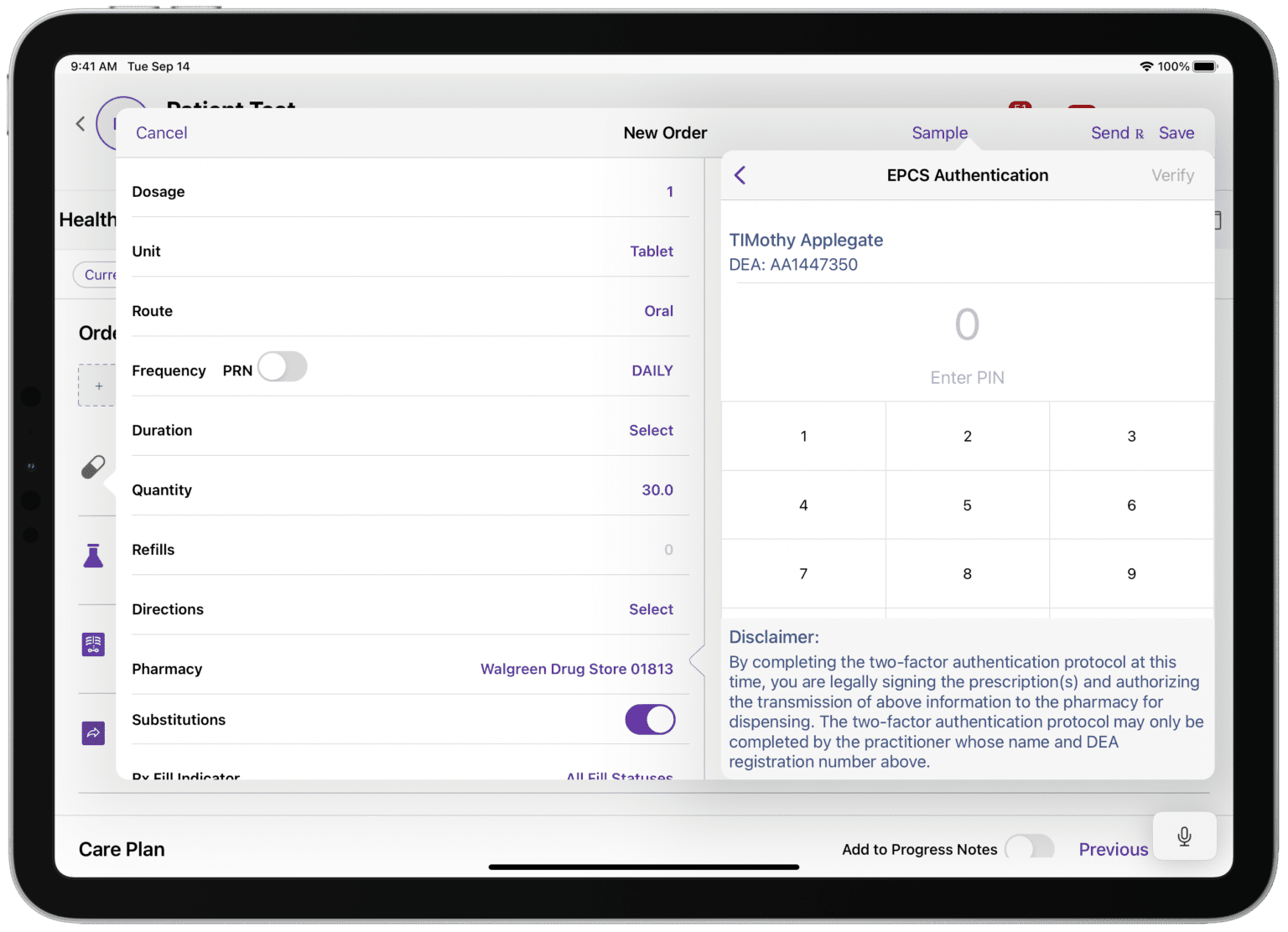
Writing a controlled-substance Rx works exactly like a regular prescription, with two extra security steps at the end: your PIN and your second factor. Sent directly to the pharmacy over the Surescripts network. No fax, no paper, no phone call.
Refills & Change Requests
Pharmacy refill requests and change requests (generic substitutions, dose changes, quantity adjustments) arrive directly in Althea Smart EHR. Review the patient chart alongside the request, approve or deny with two-factor auth, and the response is back at the pharmacy in seconds.
From identity-proof to pharmacy.
In four steps.
One-time setup per provider, then every controlled-substance prescription takes the same four steps as a regular eRx, plus two-factor authentication at the end. DEA requirements satisfied without adding clinical burden.
One-time DEA-required identity proofing per provider. Choose your second factor, a hardware token or the Authy app, and you're set up to prescribe controlled substances.
Write the Schedule II–V prescription inside the patient chart, exactly the same workflow as any other medication. Drug, dose, quantity, refills, directions.
Enter your PIN. Then tap your token or approve the push notification in the Authy app. Two-factor authentication satisfies 21 CFR 1311 signing requirements.
Signed Rx is transmitted to the pharmacy over the Surescripts network in seconds. Patient's chart is updated automatically, audit log captures the transaction, and you're done.
See the transformation
Same patient, same medication, two completely different workflows. One involves a locked drawer and a fax machine. The other takes about ten seconds.
Old Way Althea Smart EHR EPCS Independently Rated. Federally Certified.
Physician Approved.


Althea Smart EHR EPCS
The essentials, authentication, compliance, pharmacy network, and setup, answered briefly.
Both satisfy DEA two-factor requirements. A hardware token is a small physical key fob that generates a code, good for providers who want a dedicated device kept on a lanyard or in a drawer. The Authy app runs on your phone and approves prescriptions with a push notification, good for providers who want one less thing to carry. Pick per provider; you can mix and match within a practice.
Yes. Althea Smart EHR EPCS meets DEA 21 CFR 1311 requirements for electronic prescribing of controlled substances, including identity proofing, two-factor authentication, digital signing, and audit logging. Every controlled-substance transaction is logged and recoverable for audit.
Each provider completes a one-time DEA-required identity-proofing process before they can sign controlled-substance prescriptions, verifying credentials, DEA number, and registering the second factor. MD Synergy walks you through this at go-live; most providers are set up in under 20 minutes.
All controlled schedules where electronic prescribing is permitted, Schedule II, III, IV, and V. This includes stimulants (Adderall, Ritalin, Vyvanse), benzodiazepines (Lorazepam, Alprazolam, Clonazepam), opioids (Oxycodone, Hydrocodone), and sleep medications.
Transmission runs over the Surescripts network, which covers virtually every retail pharmacy in the US, CVS, Walgreens, Rite Aid, Walmart, Kroger, independents, and mail-order pharmacies like Express Scripts. If your patient’s pharmacy accepts electronic prescriptions, you can send to it.
Refill requests and change requests (generic substitution, dose changes, prior auth questions) from the pharmacy arrive directly in Althea Smart EHR. You review the request alongside the patient’s chart, approve or deny with your PIN + second factor, and the response is back at the pharmacy in seconds. No fax, no phone tag.
Every EPCS transaction is captured in a tamper-evident audit log, prescription details, provider identity, timestamp, second-factor method, pharmacy destination, and transmission status. Logs are available to authorized practice administrators for internal review or DEA audit response.
Retire the paper Rx pad.
A 15-minute live demo is the fastest way to see Althea Smart EHR EPCS in action with your own workflow.
Schedule Your Free Demo