Medical documentation has long been one of the biggest challenges in healthcare. Physicians spend hours completing notes after patient visits, often leading to burnout and reduced time for patient care.

Today, AI ambient charting is changing that reality.

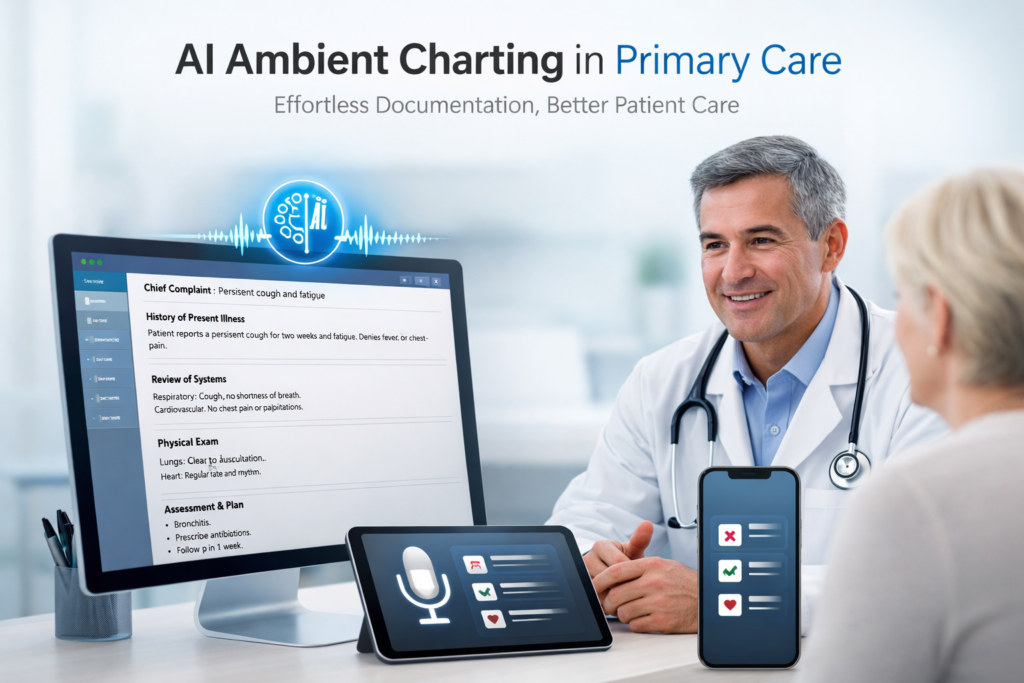
By capturing conversations during patient visits and converting them into structured clinical notes in real time, this technology is transforming how providers document care.


What Is AI Ambient Charting

AI ambient charting uses advanced voice recognition and natural language processing to listen during patient encounters and automatically generate clinical documentation.

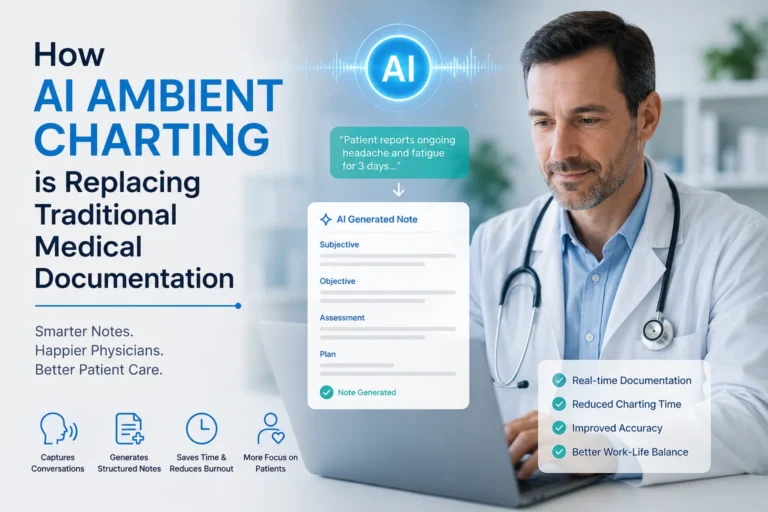
Instead of typing or dictating after the visit, the system creates structured notes such as SOAP documentation while the conversation is happening.

With Althea Smart EHR, physicians can review and finalize notes quickly without disrupting their workflow.


The Problem with Traditional Medical Documentation

Traditional documentation methods create several challenges:

  • Time-consuming charting after hours
  • Increased physician burnout
  • Inconsistent documentation quality
  • Reduced patient interaction during visits

Many providers report spending more time with their computers than with their patients. This impacts both efficiency and patient satisfaction.


How AI Ambient Charting Improves Clinical Workflows

AI ambient charting brings a new level of efficiency to clinical workflows.

1. Real-Time Documentation

Notes are created during the visit, not after. This reduces the need for after-hours charting.

2. Improved Patient Engagement

Physicians can focus on the patient instead of typing on a screen.

3. Structured and Accurate Notes

AI organizes conversations into clinical formats such as SOAP notes, Review of Systems, and Physical Exam.

4. Faster Encounter Closure

Providers can complete documentation immediately, which accelerates billing and claim submission.


AI Ambient Charting vs Traditional Documentation

Feature Traditional Documentation AI Ambient Charting
Time spent charting High Significantly reduced
Patient interaction Limited Improved
Documentation speed Slow Real time
Workflow efficiency Manual Automated

Reducing Physician Burnout with AI

One of the biggest benefits of AI ambient charting is its impact on physician burnout.

By eliminating hours of manual documentation, providers can:

  • Leave the office on time
  • Spend more time with family
  • Focus on patient outcomes instead of paperwork

This shift is critical as healthcare continues to evolve toward value based care models.


AI in Healthcare Is Becoming Essential

AI in healthcare is no longer optional. It is becoming a core part of modern medical practice.

From predictive analytics to automated documentation, AI powered EHR systems are helping practices improve efficiency and financial performance.

Solutions like Althea Smart EHR combine AI ambient charting with features such as predictive charting, RAF score detection, and automated workflows.


What to Look for in an AI Ambient Charting Solution

When evaluating AI ambient charting, practices should consider:

  • Accuracy of generated notes
  • Ability to customize templates
  • Integration with existing workflows
  • Compliance with HIPAA requirements
  • Ease of use for providers

Choosing the right platform ensures long term success and adoption.


Why Practices Are Switching to AI Powered EHR Systems

Many primary care and internal medicine practices are now transitioning to AI powered EHR platforms.

Key reasons include:

  • Reduced documentation time
  • Improved coding accuracy
  • Better patient engagement
  • Increased revenue through faster billing cycles

With solutions from MD Synergy Solutions, practices can switch without risk, thanks to free training, data migration, and flexible onboarding.


The Future of Medical Documentation

AI ambient charting represents the future of medical documentation.

As technology continues to improve, documentation will become faster, more accurate, and less intrusive.

Physicians will spend less time on administrative tasks and more time delivering high quality patient care.


Conclusion

AI ambient charting is transforming healthcare by replacing outdated documentation methods with intelligent automation.

For practices looking to improve efficiency, reduce burnout, and enhance patient care, adopting an AI powered EHR is a strategic move.

Call to Action

Ready to experience AI ambient charting in your practice?

Explore how Althea Smart EHR can help you streamline documentation and focus on what matters most.

Previous

Maximizing Telehealth Success Through EHR Integration

Introduction

Choosing the right Electronic Health Record system has become one of the most important decisions for medical practices today. Many providers feel stuck using outdated systems that slow them down instead of helping them deliver better care.

If you are searching for EHR alternatives, you are not alone. Practices across the country are actively switching to more modern platforms that improve workflow efficiency, reduce documentation burden, and support value based care.

This guide breaks down how to evaluate EHR alternatives, what features matter most, and how newer AI driven platforms are changing the landscape.


Why Practices Are Looking for EHR Alternatives

Healthcare providers are moving away from traditional EHR systems for several reasons.

Common challenges with legacy EHR systems

  • Excessive clicks and time spent charting
  • Poor user experience and outdated interface
  • Limited support for value based care workflows
  • High costs for setup, training, and data migration
  • Difficulty accessing patient data across systems
  • Lack of innovation in AI and automation

Many of these systems were designed years ago and have not evolved to meet modern clinical demands.


What to Look for in an EHR Alternative

When comparing EHR systems, it is important to focus on features that directly impact clinical efficiency and financial performance.

1. Ease of Use and Speed

A modern EHR should reduce clicks and allow providers to complete documentation quickly. Intuitive workflows and mobile access are essential.

2. AI Driven Documentation

AI powered tools such as ambient charting and predictive charting can significantly reduce documentation time and physician burnout.

3. Value Based Care Support

Look for features that help identify care gaps, track RAF Scores, and improve HCC coding accuracy.

4. Interoperability

Seamless integration with labs, radiology, pharmacies, and health information exchanges is critical.

5. Patient Engagement Tools

Patient portals, automated notifications, and digital communication improve patient satisfaction and reduce administrative workload.

6. Transparent Pricing and Flexibility

Avoid systems with hidden fees or restrictive contracts. Look for vendors offering flexible onboarding and risk free switching options.

EHR Comparison Table

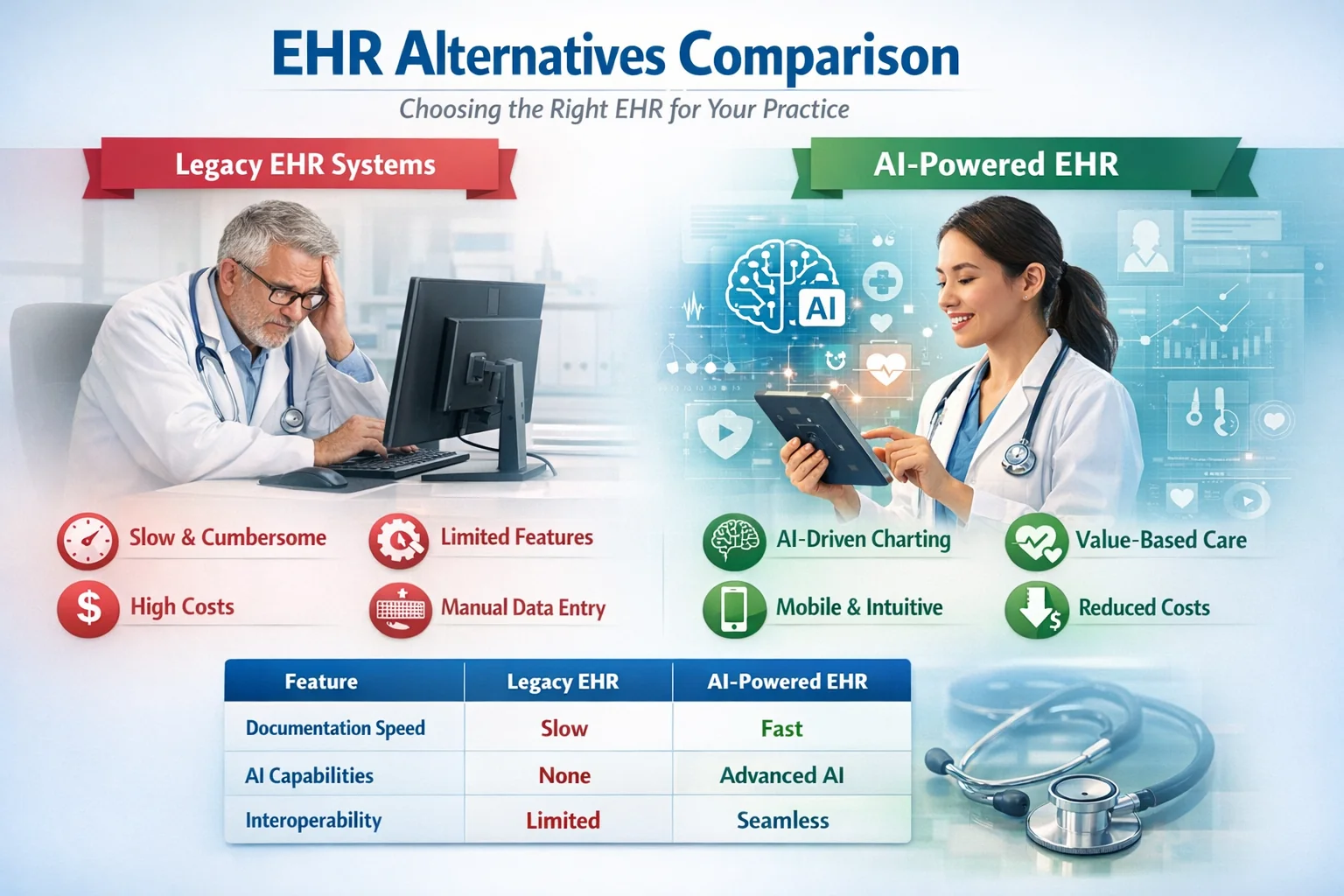
Below is a simplified comparison of common EHR categories to help guide your decision.

Feature Legacy EHR Systems Cloud Based EHR AI Powered EHR
User Experience Complex and outdated Improved Modern and intuitive
Documentation Speed Slow Moderate Fast with automation
AI Capabilities Limited Basic Advanced AI assistance
Value Based Care Tools Minimal Moderate Built in and proactive
Mobile Access Limited Available Fully optimized
Setup Costs High Moderate Often low or zero
Innovation Slow Moderate Rapid

Why AI Powered EHR Systems Are Gaining Momentum

The biggest shift in healthcare technology today is the adoption of AI powered EHR platforms.

These systems go beyond basic record keeping and actively assist providers during patient care.

Key advantages

  • Ambient charting that captures visits automatically
  • Predictive suggestions for orders and treatment plans
  • AI driven insights for RAF and HCC coding
  • Faster documentation with fewer clicks
  • Improved compliance and accuracy

Practices using modern platforms are seeing measurable improvements in both efficiency and revenue.


A Modern Approach to EHR: What Sets New Platforms Apart

New generation EHR systems are designed with physicians in mind.

Instead of forcing providers to adapt to software, these platforms adapt to how clinicians work.

For example, solutions like Althea Smart EHR from MD Synergy focus on:

  • Mobile first workflows for iPhone and iPad
  • AI powered clinical assistance
  • Real time patient data access
  • Integrated communication tools
  • Simplified user experience inspired by consumer technology

This shift is helping practices spend more time with patients and less time on documentation.


When Should You Switch Your EHR

If your current system is holding your practice back, it may be time to consider switching.

Signs you need an EHR alternative

  • You spend more time charting than seeing patients
  • Your system does not support value based care initiatives
  • Staff productivity is declining
  • Reporting and analytics are limited
  • You are paying high fees with little return

Switching EHR systems used to be difficult, but modern vendors now offer streamlined migration processes with minimal disruption.

How to Evaluate EHR Alternatives

Before making a decision, follow a structured evaluation process.

Step by step approach

  1. Identify your practice needs and workflows
  2. Request live demos focused on real clinical scenarios
  3. Compare features that impact efficiency and revenue
  4. Review total cost including hidden fees
  5. Ask about Data Migration and onboarding support
  6. Speak with current users for real feedback

Taking the time to evaluate properly can prevent costly mistakes.


Conclusion

The EHR landscape is evolving rapidly. Practices that continue using outdated systems risk falling behind in both efficiency and patient care.

Exploring EHR alternatives is not just about switching software. It is about transforming how your practice operates.

Modern AI powered platforms are helping providers reduce burnout, improve documentation accuracy, and increase revenue opportunities.

Practices that adopt the right technology today will be better positioned for the future of healthcare.

FAQ Section for SEO

What is the best EHR alternative in 2026

The best EHR alternative depends on your practice size and specialty. Many providers are choosing AI powered EHR systems that offer faster documentation, better workflows, and improved value based care support.

Why are doctors switching EHR systems

Doctors are switching due to poor usability, high costs, and lack of innovation in older systems. Modern EHR alternatives provide better efficiency and reduce administrative burden.

Are AI powered EHR systems worth it

Yes AI powered EHR systems can significantly reduce documentation time, improve coding accuracy, and enhance patient care through automation and intelligent insights.

How difficult is it to switch EHR systems

Switching used to be complex, but many modern vendors now offer free data migration, onboarding support, and minimal downtime during transition.

What features should I look for in an EHR system

Key features include ease of use, AI documentation tools, interoperability, patient engagement tools, and value based care support such as RAF and HCC tracking.

Can switching EHR improve revenue

Yes a modern EHR can improve revenue by capturing missed coding opportunities, improving billing accuracy, and increasing provider productivity.

Previous

Maximizing Telehealth Success Through EHR Integration

Next

How AI Ambient Charting Is Replacing Traditional...

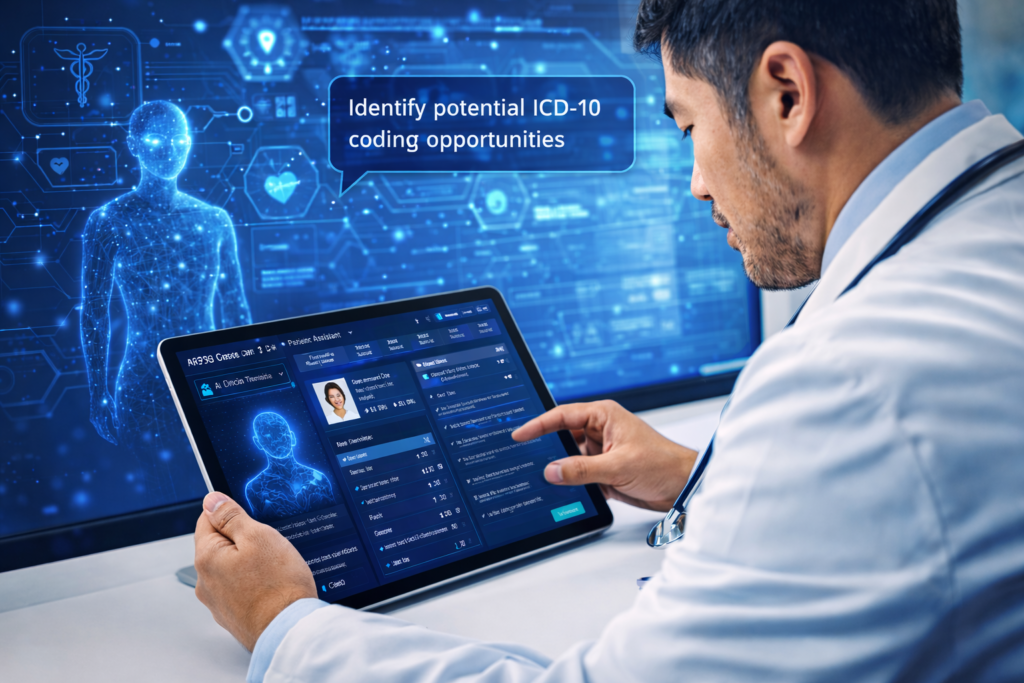
In today’s fast-paced healthcare environment, physicians face increasing documentation demands that take time away from patient care. As a result, many providers are turning to AI-powered EHR systems to streamline workflows and reduce administrative burden.

One of the most impactful innovations is AI predictive charting in EHR systems. Althea Smart EHR uses artificial intelligence to analyze your clinical patterns and automatically suggest orders, diagnoses, and treatment plans—helping you chart faster and more accurately.


What Is AI Predictive Charting in EHR?

AI predictive charting is an advanced feature within modern electronic health record systems that uses machine learning to anticipate clinical actions.

Instead of repeatedly entering the same orders, the system learns from your historical data and suggests the most relevant next steps. Over time, it becomes more accurate and personalized to your workflow.


How AI Improves EHR Systems

Artificial intelligence is transforming how providers interact with EHR platforms. With predictive charting:

  • Documentation becomes faster and more efficient
  • Clinical accuracy improves through data-driven suggestions
  • Providers spend more time with patients instead of screens

As a result, AI in EHR systems is quickly becoming essential for modern medical practices.


Key Benefits of AI Predictive Charting

Reduce Documentation Time

AI predictive charting significantly decreases manual data entry by automatically suggesting orders and treatment plans based on past encounters. As a result, providers can complete charts faster and focus more on patient care.

Learn Your Clinical Workflow

Unlike traditional EHR templates, predictive charting adapts to your unique treatment style. Over time, the system refines its recommendations, ensuring alignment with your clinical preferences.

Improve Clinical Accuracy

By leveraging historical data and intelligent suggestions, predictive charting reduces variability and minimizes documentation errors. This leads to more consistent and reliable patient records.

Deliver Actionable Insights

The system continuously evolves with usage. Therefore, each patient encounter benefits from increasingly accurate and meaningful recommendations.


AI Predictive Charting + Ambient Charting: A Complete Solution

AI predictive charting becomes even more powerful when combined with ambient charting.

  • Ambient charting captures real-time patient-provider conversations
  • Predictive charting builds on that data to suggest next steps

Together, they create a seamless, end-to-end clinical documentation workflow.


Why AI-Powered EHR Is the Future

Healthcare is rapidly shifting toward automation and intelligence-driven workflows. Practices that adopt AI-powered EHR solutions gain:

  • Increased efficiency
  • Reduced physician burnout
  • Better patient outcomes

As a result, AI predictive charting is becoming a critical competitive advantage for modern practices.


Discover the Future of EHR with AI

AI predictive charting is transforming clinical documentation by making it faster, smarter, and more personalized.

By combining predictive intelligence with ambient charting, Althea Smart EHR enables providers to reduce administrative burden while improving patient care.

Ready to see it in action?
Althea Smart EHR


FAQ

What is AI predictive charting in EHR?

AI predictive charting uses machine learning to suggest orders, diagnoses, and treatments based on historical clinical data.

How does AI reduce documentation time?

It automates repetitive tasks and provides intelligent suggestions, reducing manual data entry.

Is AI in EHR systems safe?

Yes, when designed with HIPAA compliance, AI enhances accuracy and efficiency without compromising data security.

Previous

Maximizing Telehealth Success Through EHR Integration

Next

How AI Ambient Charting Is Replacing Traditional...